
About to take the keys on a new build? Get a new home handover inspection done before you make that final payment.
I’ve been in the building game 40 years. Carpenter, builder, now licensed inspector. In all that time I’ve never seen a house come out of construction perfect. Not one. There are too many trades on a job, too many moving parts, and everyone is working to someone else’s deadline.
That doesn’t make your builder a shonk. It just means things get missed.
What matters is the timing. Before you sign off on practical completion, the builder has to put it right. Once you’ve signed and paid, you’re in a much weaker spot, and a fair bit of it becomes your bill.
What is a new home handover inspection?
It’s an independent inspection of your brand-new build before you make the final payment and take the keys.
Your builder runs their own final check. That’s their inspector, looking at their work, against their standard. I’ve got nothing to do with them. I’m working for you.
I go through the property properly and write up everything that’s incomplete, badly done, or not to standard. You get that list in writing with photos on it. Then you sit down with the builder while you still have some leverage.
It’s a different job to a pre-purchase building inspection, which is what you’d get done on an established home before you buy it. Different property, different defects, different questions to ask.
Do new homes really have defects?
Yes. More often than you’d think, and usually more of them than people are expecting.
The things I find most on new builds are waterproofing in wet areas that hasn’t been done properly, roof work left half finished, drainage falling the wrong way, doors that bind, windows that won’t seal, and fitoff that’s been rushed at the end of the job. Paint holidays and rough edges are almost a given.
Caloundra is a good example of how it plays out. When I’m doing building and pest inspections in Caloundra, the old beach shacks have their own set of problems, asbestos and dodgy wiring mostly. But the new estate homes have builder defects. Same suburb, completely different job.
I inspected a place once that was under eight years old. Cement sheet cladding, modern build, looked spotless from the street. The previous owners had put garden beds in hard up against the cladding with no clearance at all. Termites came straight through that contact point and had a clear run at the timber framing behind it. Nothing about that house looked like a problem until you got up close to it.
New and new-looking are two different things. Here’s an example of external caulking with inconsistent finish and gaps along. This can lead to water ingress over time.

Why not just trust the builder's sign-off?
Because their inspector works for them and I work for you. That’s the whole difference.
I’m not saying builders are dishonest. Most of them aren’t. But nobody marks their own homework hard. A builder’s final check is looking to confirm the job’s finished. I’m looking for what’s wrong with it. You get very different lists.
There’s a practical side to it as well. If you rock up on handover day and tell the site supervisor you’re not happy about a few things, that conversation goes nowhere. Hand them a written report from a QBCC licensed inspector with photos and item numbers on it, and it goes somewhere. I’ve watched that play out plenty of times.
If you want to know more about how I work, there’s a bit about my background and 40 years in the building trade on my about page.
When should I book my handover inspection?
Before final payment, and before you sign off on practical completion. That’s the window that counts.
The moment your builder tells you the home has hit practical completion, book it in. Don’t sit on it. You want the report in your hands with enough time to raise the issues and get a response before any money changes hands.
If you’ve already moved in, you’re not completely out of options. Queensland’s defects liability period on domestic building work runs around six months from practical completion, and you can still get an inspection done inside that. But the further into it you get, the harder it is. Raising something in month five means you’re relying on the builder to assess it, schedule it and actually fix it before the clock runs out. That’s cutting it fine.
Earlier is better on this one. Always.
What I check on a handover inspection
The lot. Roof to slab, inside and out.
I get up on the roof, which not every inspector bothers doing. Ridge capping, tile alignment, flashings at the penetrations and the valleys. Roof problems cost the most to sort out later, so I don’t take anyone’s word on it.
Outside I’m looking at render cracking, how the ground falls away from the slab, whether the site’s been cleared properly, cladding clearances and seals. I check every door and window by hand, opening and closing each one. A door that sticks usually means something else is going on behind it.
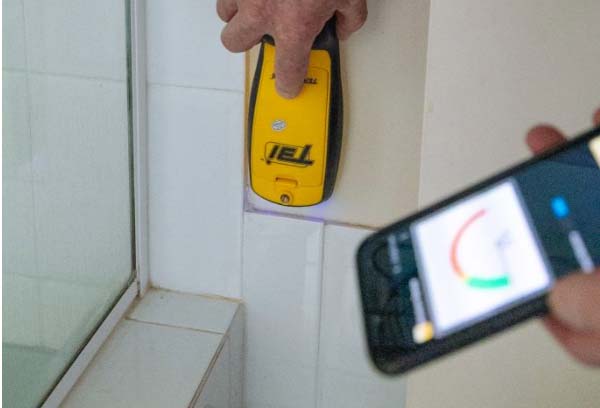
Wet areas get the most attention. Bathrooms, ensuite, laundry. I run the Tramex moisture meter across the tiling to see what’s happening behind it, because waterproofing failures in new builds are common and you can’t spot them by eye until the damage is already done. The FLIR Cx3 thermal camera goes over the walls and ceilings for the same reason. Moisture shows up on thermal well before it shows up on your ceiling.
Then there’s the fitoff. Tapware, toilets, shower screens, drainage under the vanities, hot water commissioning, flexy hoses. A badly fitted flexy hose in a brand new house is a flood waiting to happen and I come across them regularly. Power points, light fittings, switches, exhaust fans, safety switch. Paint, finishes, edges, colour matching.
I use a Bosch laser level on floors and walls so anything out of tolerance gets measured rather than guessed at.
If you want to see how the report actually reads, have a look at the sample inspection report. That’s the format you’ll get.
What happens after the inspection?
You get the written report inside 24 to 48 hours, and I go through the findings with you on site before I leave.
The report is colour coded, red and green, with photos on every item. Plain English. Nothing in there you need to look up.
I don’t just email it through and disappear. I walk you around the property at the end and show you what I’ve found, so you actually understand what’s in the report before you take it anywhere near your builder.
From there, send the whole thing through to the site supervisor or project manager in writing. Email it. Don’t rely on a chat on site. You want a record of when you raised it and what you raised. Ask for a written response with dates against each item.
If the builder pushes back on something, you’ve got a licensed inspector’s report sitting behind you, and that’s what a QBCC dispute would be built on if it ever got that far. Anything they can’t fix before settlement needs to be in writing with a date and a consequence attached to it. Talk to your solicitor about that part before you sign anything.
You can see the full range of my building and pest inspection services if you want to know what else I cover across the Sunshine Coast and Gympie.

Book your handover inspection
I do every inspection myself. No contractors, no juniors, nobody else turning up in my place.
Pricing starts at $399. A standard four bedroom two bathroom new build usually lands somewhere between $539 and $619. Give me a ring and I’ll price your actual property.
Book your handover inspection online or call me on 0469 904 139.
Don’t sign it off until someone’s had a proper look at it.
FAQ
What’s the difference between a handover inspection and a pre-purchase inspection? A pre-purchase inspection is done on an established home before you buy it. I’m looking at structural condition, pest activity and general wear. A handover inspection is on a brand new build before you take possession, so I’m looking at workmanship, finishes and whether the builder has actually finished the job to standard. Different property, different defects.
Can I get a handover inspection after I’ve already moved in? Yes. Queensland’s defects liability period on domestic building work runs around six months from practical completion, and you can still get an inspection done inside that window. Don’t leave it though. The closer you get to the six month mark, the less time there is to raise a defect and have the builder actually deal with it.
How much does a handover inspection cost on the Sunshine Coast? Pricing starts at $399 depending on the size of the property. A standard four bedroom two bathroom new build is usually between $539 and $619. Call 0469 904 139 and I’ll give you a price on your specific home.
What if the builder disputes the defects? You’ve got a QBCC licensed inspector’s report with photos behind you, which is a very different conversation to a verbal complaint on handover day. If the builder won’t act on legitimate defects, that report is the basis for a formal dispute through the QBCC. Hard for a builder to wave away.
How long does a handover inspection take? Depends on the size of the place. A standard four bedroom two bathroom new build takes me two to three hours. I don’t rush them. You’re welcome to be there and I’ll walk you through everything at the end.